 English
 한국어
한국어 français
 Español
 русский
 português
 العربية
 tiếng việt
 Türkçe
 ไทย
ไทย Polska
Choosing between a single-station and a double-station machine is not simply a question of buying the faster model. The correct choice depends on the product, cooling demand, mold investment, output target, available floor space, changeover frequency and the amount of downstream automation required.
Blow molding forms hollow thermoplastic products by placing a hot parison in a mold and inflating it with pressurized air until it takes the shape of the mold cavity. In continuous extrusion blow molding, a single-station machine has one mold-and-clamp position, while a double-station machine has two positions that alternately receive the extruded parison.
That definition sounds straightforward, but the purchasing decision is more nuanced. A second station can improve the use of extrusion and cooling time, yet it also adds mold, handling, control and maintenance considerations. Double station is therefore not automatically the better investment.
How Does a Single-Station Blow Molding Machine Work?
A single-station system uses one mold carriage or clamping position. The parison is extruded, captured by the mold, blown, cooled and removed before the next molding sequence begins. The exact movement depends on the machine design, but one station performs the forming cycle at a time.
This arrangement is often practical when the product is large, the mold is heavy, the cooling cycle is long, or production volume does not justify an additional station. It may also suit factories that run many product variants and need to change molds frequently.
Its main advantage is simplicity. There are fewer moving assemblies to coordinate, fewer mold sets to maintain and a more direct production flow for operators to understand. Initial investment, floor-space requirements and commissioning work may also be easier to manage.
The limitation is that the extrusion system may wait while the part is being cooled or handled. Whether this becomes a serious productivity issue depends on the balance between parison extrusion time, mold cooling time and downstream operations.
How Does a Double-Station Blow Molding Machine Work?
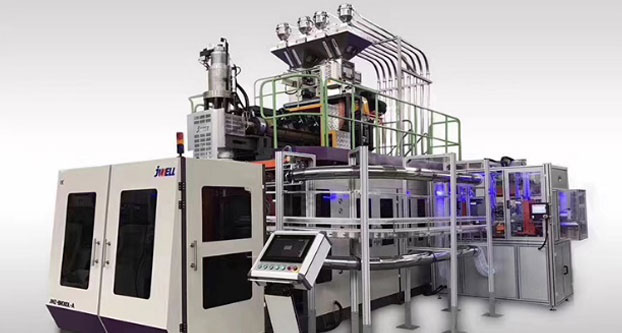
A double-station system uses two mold-and-clamp positions with a shared extrusion arrangement. While one station is blowing or cooling a part, the other can move into position for the next parison. This alternating sequence can reduce idle time when the extruder, mold movement and cooling cycle are properly matched.
A double station blow molding machine is commonly considered for repeat production of bottles, containers and other hollow parts where output consistency matters. Its value is strongest when both stations can operate with a stable rhythm and the downstream line can accept the increased flow of finished parts.
However, a second station does not guarantee twice the output. The extruder must supply enough stable melt, the die head must form consistent parisons, cooling must remain effective, and trimming or inspection equipment must keep pace. If one of these elements becomes the bottleneck, the extra station may be underused.
Single-Station vs Double-Station: Key Differences
| Comparison Point | Single-Station Machine | Double-Station Machine |
| Production flow | One mold position completes the cycle | Two mold positions operate alternately |
| Initial configuration | Generally simpler | Requires additional station hardware and controls |
| Output potential | Suitable when demand is moderate or cycles are product-led | Better suited to stable, repeat production when the full line is balanced |
| Mold requirement | Usually one active mold set | May require matched molds and tighter process consistency |
| Floor space | Usually easier to fit into a compact layout | Needs more room for station movement and part handling |
| Changeovers | Often easier for varied, lower-volume programs | Best when longer production runs justify setup effort |
| Maintenance | Fewer coordinated moving systems | More station components and synchronization points |
| Best-fit use | Large parts, flexible schedules or moderate demand | Repeatable container production and higher output targets |
Which Factors Should Guide the Decision?
Product Size and Geometry
Large parts may require substantial clamping space, heavy molds and extended cooling. In such cases, a single station can be the more practical layout. Smaller repeat products may benefit more from alternating stations, especially when the parison can be produced continuously and handled consistently.
Required Output
Start with verified demand rather than the highest theoretical capacity. Calculate the required good parts per shift, then allow for changeovers, maintenance, quality checks and realistic operating efficiency. A double-station system makes sense only when the sales plan and downstream equipment can use the added capacity.
Cooling Time
Cooling often controls the real production rhythm. If the mold remains occupied for a long period, alternating stations can keep the extrusion system productive. If cooling is already short compared with parison formation and handling, the benefit may be smaller than expected.
Mold Budget and Changeover Frequency
A double-station project may need matched tooling, additional water connections and more setup verification. This is easier to justify for stable products with long runs. A factory producing frequent small batches may value faster, simpler changeovers more than maximum output.
Automation Scope
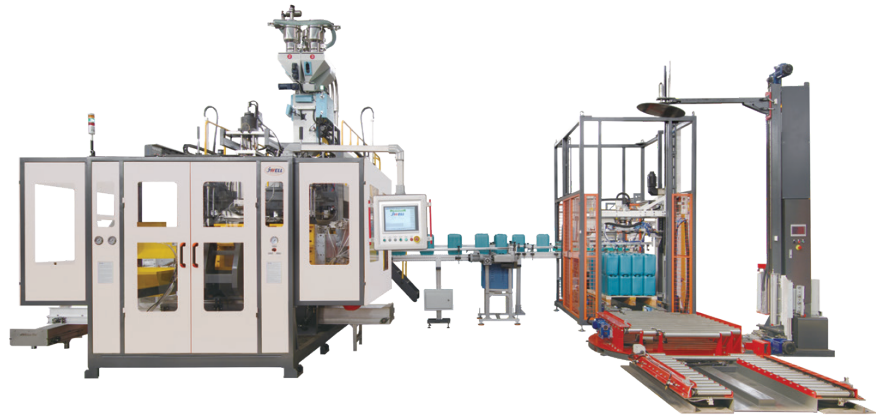
Part removal, deflashing, conveying, leak testing and scrap handling must match the molding cycle. An automatic extrusion blow molding machine should therefore be evaluated as a complete production cell, not only as a molding unit. Poorly matched downstream equipment can erase the productivity gained by the second station.
Energy and Utility Use
Machine selection should include extruder drives, hydraulic or servo systems, mold cooling and compressed-air demand. The U.S. Department of Energy identifies motor selection, process chilling and compressed-air system design as relevant energy-efficiency areas in plastics manufacturing. Compare utility requirements under the same product and output conditions rather than relying on a general “energy-saving” claim.
When Is a Single-Station Machine the Better Choice?
A single-station machine is often the better fit when production involves large hollow parts, heavy tooling, lower annual volume or frequent product changes. It can also be attractive when factory space, mold budget or operator experience is limited.
For smaller container projects, buyers may review a 5 Ltr blow moulding machine configuration and then decide whether the expected output requires a single- or double-station layout. The decision should follow the actual bottle design, material, cavity arrangement and handling plan.
When Is a Double-Station Machine the Better Choice?
A double-station machine is more compelling when the factory runs repeat products for long periods, cooling time leaves the extruder underused, and there is steady demand for additional output. It is also useful when automated trimming and conveying can receive parts from alternating stations without creating congestion.
Before choosing it, ask the supplier to demonstrate the production sequence using your material and product design. The proposal should explain extrusion capacity, station movement, mold cooling, part removal and expected good-part output as one connected process.
Questions to Ask Before Ordering
What is the required good-part output under normal factory conditions?
Which step is expected to control the cycle: extrusion, blowing, cooling or handling?
Will both stations use identical molds and cooling circuits?
What happens to production if one station requires maintenance?
Are deflashing, conveying and leak testing included in the proposed scope?
How long will mold changes and product setup take?
Which utilities and auxiliary machines are required?
Can the supplier conduct a trial using the intended resin and product drawing?
Buyers can compare the wider blow molding machine range before narrowing the project to a station layout. Information from jwell should be reviewed together with product samples, tooling requirements and an agreed acceptance plan.
Summary
Choose a single-station machine for simpler operation, flexible production, heavy molds or moderate demand. Choose a double-station machine when repeat production, cooling time and downstream automation justify alternating mold positions. The best decision comes from a balanced line study covering the product, mold, extruder, cooling, utilities and handling—not from station count alone.
If you are still unsure which configuration fits your specific bottle design, send your product drawing to our engineering team for a free cycle-time simulation.
Frequently Asked Questions
Does a double-station blow molding machine always produce twice as much?
No. Output also depends on extrusion capacity, cooling, mold design, part handling and downstream equipment. Any bottleneck can limit the benefit of the additional station.
Is a single-station machine only suitable for low-volume production?
No. It may be the better engineering choice for large parts, heavy molds or products with long cooling cycles, even when the machine operates regularly.
Which machine is easier to maintain?
A single-station layout is generally simpler because it has fewer coordinated station components. Maintenance quality still depends on machine design, component access and spare-parts support.
Can a double-station machine run different products at the same time?
It should not be assumed. The products must be compatible with the shared extrusion, die-head and process conditions. Most projects use matched production to maintain stable operation.
What information should be sent to the machine supplier?
Provide the product drawing, material, part weight, output target, mold details, automation requirements, utility standards and available floor space.