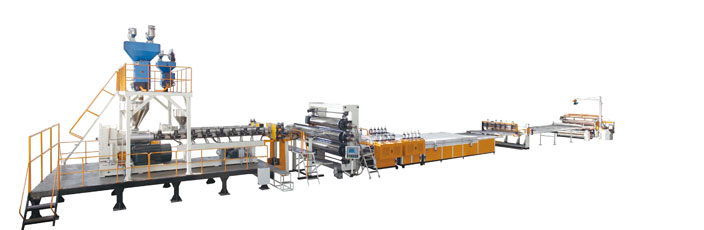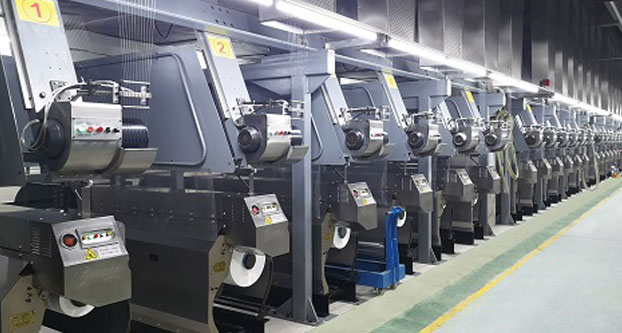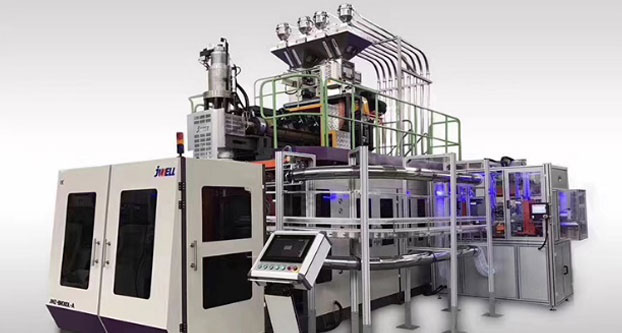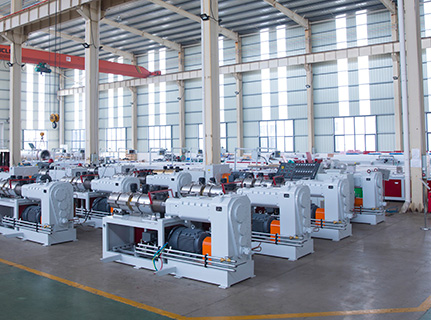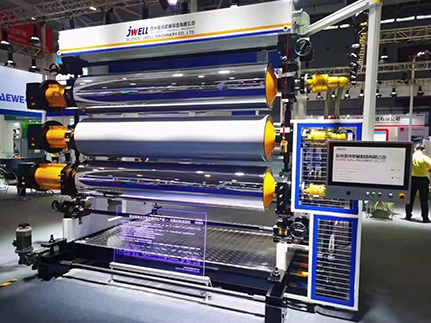
A pipe extruder machine is a core piece of equipment in modern plastic manufacturing, designed to continuously transform polymer raw materials into pipes with consistent diameter and wall thickness.
A pipe extruder machine is an industrial system that melts thermoplastic resin such as HDPE and forces it through a die to form continuous pipes with controlled dimensions and surface quality.
Among different types, the HDPE pipe extruder is the most widely used in water supply, gas distribution, and industrial piping systems due to its stability, durability, and cost efficiency.
In this article, we explain how an extrusion pipe machine works, its key components, and why HDPE technology has become the global standard for pipe production.
A pipe extruder machine is not a single device but a complete production line that works continuously. It converts raw plastic pellets into pipes using heat, pressure, and controlled cooling.
In industrial applications, the HDPE pipe extruder is preferred because HDPE (High-Density Polyethylene) offers strong chemical resistance, long service life, and excellent mechanical strength.
According to polymer industry research, HDPE pipes are widely used in water and gas pipelines due to their corrosion resistance and flexibility under pressure conditions (Wikipedia – High-density polyethylene).
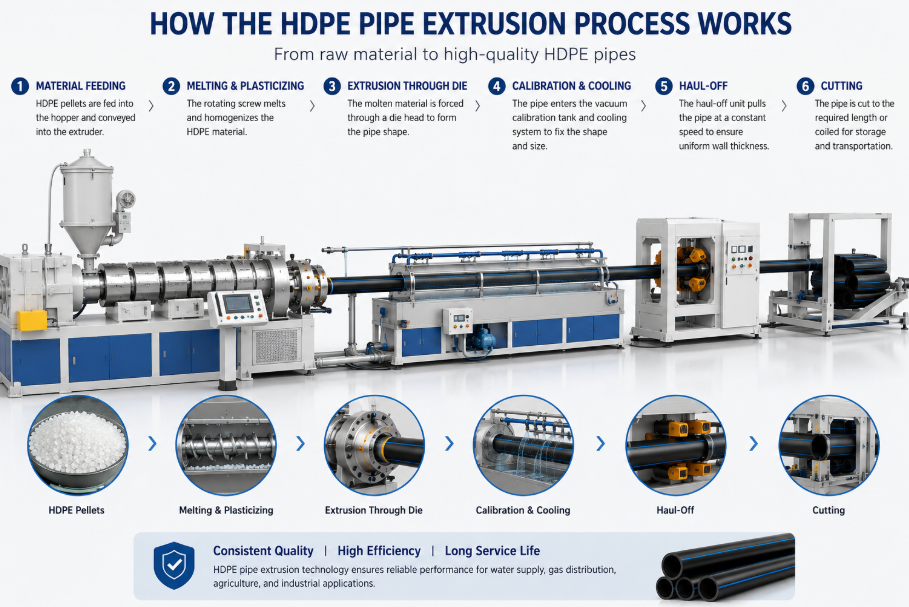
The working principle of an extrusion pipe machine is based on continuous melting and shaping. The process can be understood as a coordinated system where each stage affects final pipe quality.
HDPE pellets are fed into the hopper and transferred into the barrel of the extruder.
Inside the rotating screw, the material is gradually heated and melted into a uniform polymer melt.
The molten material passes through a circular die that defines the pipe shape and diameter.
A vacuum calibration tank fixes the outer diameter while water cooling stabilizes the pipe structure.
The pipe is pulled at a constant speed and cut into required lengths or wound into coils.
This continuous workflow ensures high efficiency and stable product quality in industrial production environments.
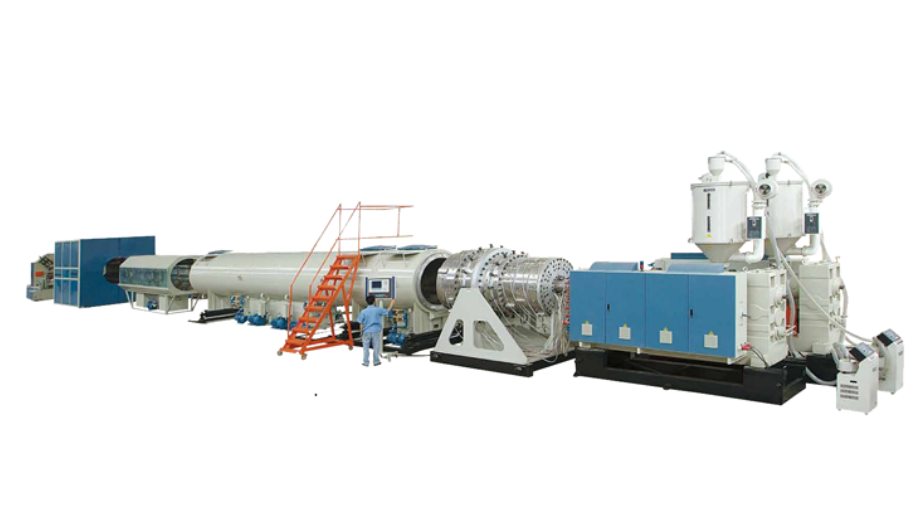
An hdpe pipe extruder is a fully integrated system composed of several precision-engineered units working together.
| Component | Function | Importance |
|---|---|---|
| Extruder screw & barrel | Melts HDPE material | Determines plasticizing quality |
| Die head | Shapes molten polymer into pipe | Controls diameter & thickness |
| Vacuum calibration tank | Fixes outer diameter | Ensures dimensional accuracy |
| Cooling system | Solidifies pipe structure | Prevents deformation |
| Haul-off unit | Pulls pipe at constant speed | Controls wall thickness |
| Cutting system | Cuts pipe to length | Ensures production consistency |
These components must operate in synchronization; even small deviations in speed or temperature can affect final pipe quality.
The performance of an extrusion pipe machine depends on precise control of several parameters:
Temperature of barrel and die system
Screw speed and torque stability
Vacuum pressure in calibration tank
Cooling water temperature and flow rate
Industry studies show that improper temperature control can lead to defects such as poor surface finish, weak mechanical strength, or dimensional instability .
The HDPE pipe extruder is widely used across infrastructure and industrial sectors:
Municipal water supply systems
Natural gas distribution networks
Agricultural irrigation systems
Electrical and telecommunication cable protection
HDPE pipes are preferred because they are lightweight, corrosion-resistant, and capable of long-distance underground installation.
The growing demand for pipe extruder machines is driven by several technical advantages:
Continuous and automated production
High output efficiency with low material waste
Long service life of produced pipes (commonly cited up to decades in infrastructure use)
Strong resistance to chemicals and environmental stress
Flexible pipe design for different diameter ranges
These advantages make HDPE extrusion technology a global standard in modern pipeline manufacturing.
Compared with steel and PVC pipelines, HDPE pipes produced by an extrusion pipe machine offer distinct advantages:
Better corrosion resistance than steel
Higher flexibility than rigid PVC systems
Easier installation with heat-fusion jointing
Lower long-term maintenance cost
These properties explain why HDPE has gradually replaced traditional piping materials in many infrastructure projects.
The importance of the HDPE pipe extruder goes beyond manufacturing. It directly impacts:
Water safety systems
Energy transportation efficiency
Infrastructure durability
Environmental sustainability
As global infrastructure continues to expand, extrusion-based pipe production remains a foundational industrial technology.
The pipe extruder machine, especially the HDPE pipe extruder, is a highly efficient system that transforms raw polymer materials into durable, precise piping systems. Through controlled melting, shaping, cooling, and pulling, an extrusion pipe machine ensures consistent quality and large-scale production. Its reliability, efficiency, and adaptability make it essential in modern infrastructure industries such as water supply, gas distribution, and agriculture. As demand for sustainable pipelines increases, HDPE extrusion technology continues to play a central role in global manufacturing.
1. What is a pipe extruder machine used for?
It is used to continuously manufacture plastic pipes by melting and shaping thermoplastic materials like HDPE.
2. What is the difference between HDPE pipe extruder and other extrusion machines?
An HDPE pipe extruder is specifically designed for high-density polyethylene, offering better strength and chemical resistance compared to general plastic extrusion systems.
3. What industries use extrusion pipe machines?
They are widely used in water supply, gas transmission, irrigation, and electrical cable protection industries.
4. Why is HDPE preferred for pipe extrusion?
HDPE offers excellent flexibility, corrosion resistance, and long service life, making it ideal for underground and high-pressure applications.
 English
 한국어
한국어 français
 Español
 русский
 português
 العربية
 tiếng việt
 Türkçe
 ไทย
ไทย Polska