 English
 한국어
한국어 français
 Español
 русский
 português
 العربية
 tiếng việt
 Türkçe
 ไทย
ไทย Polska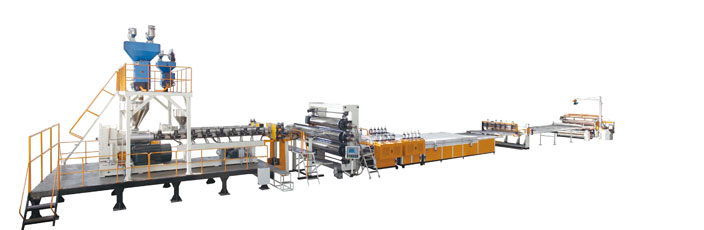
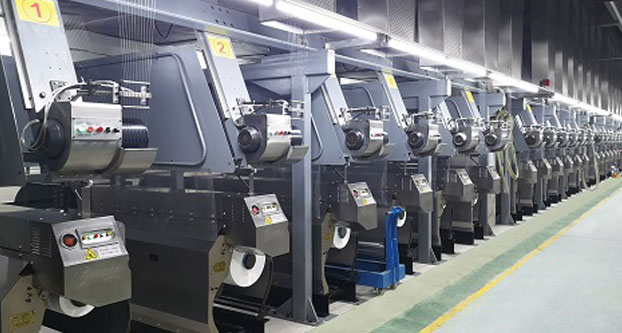
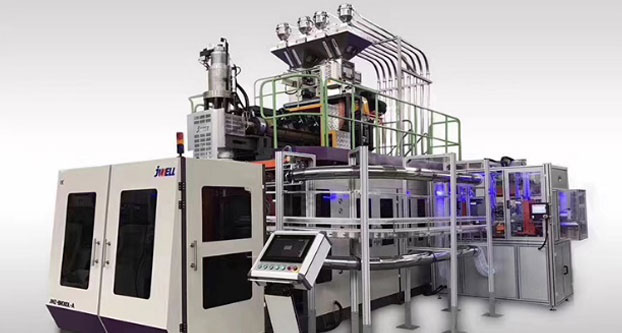
Choosing a sheet extrusion line begins with the finished sheet, not the extruder model. A line for clear thermoforming sheet may be unsuitable for a thick textured panel, even when both products use thermoplastic resin. Buyers should define the material, usable width, thickness range, output target, layer structure and downstream application before comparing quotations.
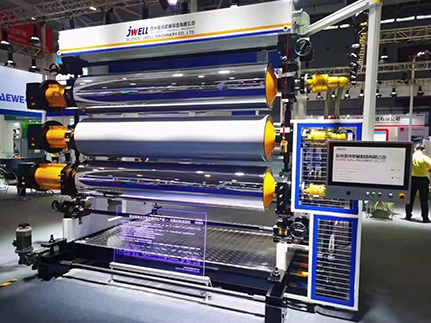
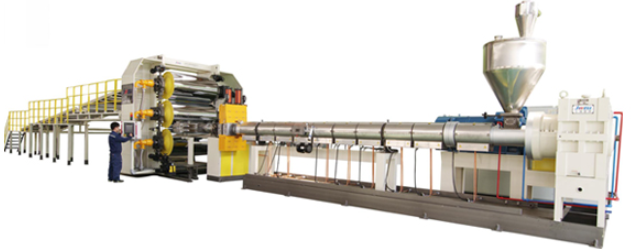
A plastic sheet extrusion line is a continuous production system that melts thermoplastic material, distributes it through a flat die, cools and calibrates it into sheet, and prepares the sheet for winding, cutting or further processing. Extrusion is a continuous forming method in which material is forced through a shaped die to create a consistent cross-section.
Start with the Finished Sheet Application
The intended product determines which technical details matter most. Thermoforming sheet needs reliable heating and forming behavior. Optical sheet requires careful surface control. Refrigerator liners and automotive panels may prioritize impact resistance, color consistency and co-extruded surfaces.
Prepare a specification covering the final application, surface finish, transparency, color, embossing, edge quality and downstream process. Also state whether the sheet will be wound, cut, laminated, printed or thermoformed. These details influence the die, roll stack, cooling arrangement and finishing equipment.
Choose the Line According to the Material
Material selection affects screw design, processing temperature, drying or degassing, filtration, roll temperature control and die construction. PET, PC, ABS, PP, PS and PVC should not be treated as interchangeable simply because each can be formed into sheet.
| Material | Typical Sheet Priorities | Important Line Considerations | Common Applications |
| PET | Clarity, toughness and thermoforming consistency | Moisture control, degassing, filtration and stable cooling | Packaging, trays and formed products |
| PC | Optical surface and dimensional stability | Accurate temperature control and careful surface handling | Construction, lighting and protective sheet |
| ABS | Impact resistance, color and appearance | Stable plasticizing and optional co-extrusion | Appliance, sanitary and automotive panels |
| PP or PS | Formability, stiffness and economical processing | Thickness uniformity, cooling and winding quality | Packaging, stationery and thermoformed products |
| PVC | Surface quality, rigidity and formulation stability | Controlled heat history and suitable screw design | Cards, decoration and industrial sheet |
For PET projects, a PET sheet extrusion line should be evaluated around the actual feedstock. Virgin pellets, production regrind and prepared recycled flakes may require different feeding, moisture-control and filtration arrangements. When recycled plastic is intended for food-contact packaging, processors should also review applicable safety and regulatory requirements.
For transparent engineering sheet, a PC Sheet Extrusion Line should provide stable melt delivery and careful surface handling. ABS projects may require an ABS sheet extrusion line configured for plain sheet or co-extruded structures.
Define Usable Sheet Width
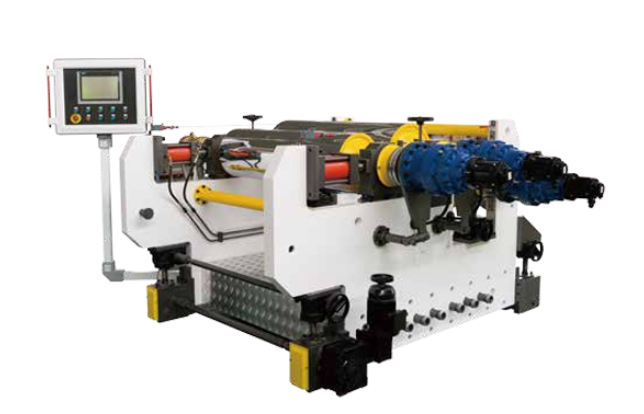
Do not specify only the nominal width of the finished product. The line must also account for edge trimming, neck-in, process adjustment and the width required by downstream equipment. The die and roll face may therefore need to be wider than the usable sheet.
Wider lines require uniform melt distribution, balanced cooling and consistent thickness from edge to edge. Provide the maximum finished width, preferred trim allowance and the widths of other products that may run on the same line.
Set a Realistic Thickness Range
Thin and thick sheet place different demands on cooling, roll gaps, winding and cutting. Define the normal production thickness as well as the occasional minimum and maximum. A line designed around frequently produced products is usually more practical than one selected around rarely used extremes.
Also state the permitted thickness variation and surface requirement. Demanding packaging, optical or technical sheet may benefit from online measurement and automatic die adjustment, while simpler products may use a less complex control approach.
Calculate Output from Saleable Sheet
Output should be based on acceptable finished sheet rather than the maximum melt rate of the extruder. Start-up scrap, edge trim, product changes, filter changes and rejected material all affect saleable production.
Ask suppliers to explain output under the intended material, width and thickness conditions. Cooling and winding can become limiting factors even when the extruder has additional capacity. Oversizing the extruder without matching the die, roll stack and finishing equipment may increase investment without delivering useful output.
Decide Between Single-Layer and Multilayer Sheet
Single-layer sheet uses one primary melt stream and is generally simpler to operate. Multilayer co-extrusion combines compatible materials so that each layer performs a function such as surface appearance, recycled-content use, stiffness, sealing behavior or barrier performance.
Adding layers may require separate feeders, additional extruders, melt pumps, a feedblock or multilayer die, and more complex start-up procedures. Before choosing a multilayer line, identify the purpose of every layer. Co-extrusion should solve a defined product, cost or performance requirement.
Review the Complete Line Configuration
A suitable plastic sheet extrusion line is more than an extruder and die. The quotation should identify material feeding, drying or degassing, filtration, melt metering, die design, roll cooling, thickness control, trimming, haul-off, winding or cutting, scrap recovery and electrical controls.
Ask how the line changes material, color, width and thickness. Review cleaning access, screen-changing procedures, roll maintenance and spare-parts availability. A useful proposal should be based on:
Material grade and recycled-content plan;
Finished application and quality requirements;
Usable width and trim allowance;
Normal and occasional thickness ranges;
Target saleable output;
Single-layer or multilayer structure;
Winding, cutting and downstream processing;
Factory utilities and available floor space;
Testing, installation, training and spare-parts scope.
Summary
Choose a sheet extrusion line by working backward from the finished product. Material determines the processing system; width and thickness shape the die, cooling and finishing sections; output must be measured as saleable sheet; and multilayer design should serve a clear purpose. A balanced, application-specific line is more valuable than an oversized machine selected from headline capacity alone.
Frequently Asked Questions
Which material information should be confirmed first?
Confirm the resin grade, additives, recycled-content ratio and final application. These details influence feeding, screw design, filtration, drying and cooling.
Why is usable width different from die width?
The line may need extra width for edge trimming and process adjustment. The supplier should calculate die and roll dimensions from the required finished sheet.
Can one line produce both thin and thick sheet?
It may be possible within a defined operating range, but normal products should guide the design. Very different thicknesses can require different cooling and finishing conditions.
Is maximum extruder output the same as finished-sheet output?
No. Finished output also depends on cooling, edge trim, start-up waste, quality acceptance and downstream handling.
When should multilayer co-extrusion be selected?
Select it when separate layers provide a measurable benefit, such as surface quality, recycled-content use, sealing performance or material savings.
What should be included in a supplier quotation?
The quotation should define the complete line scope, utility requirements, expected performance conditions, installation, training, warranty and excluded equipment.