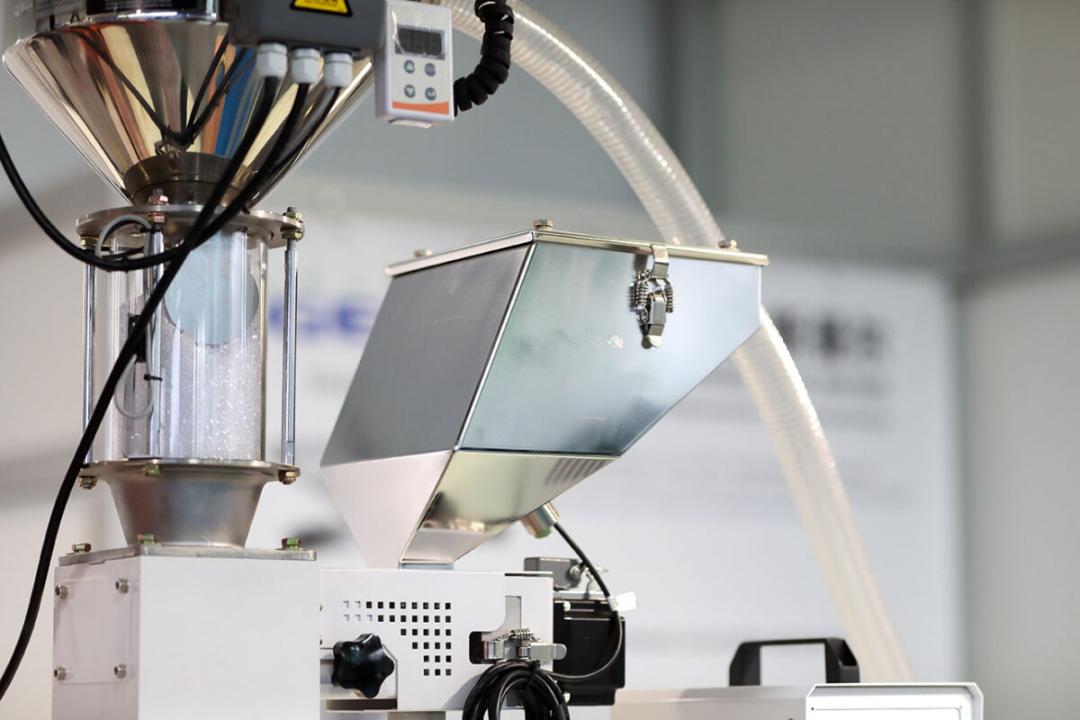
Feeders deliver materials with high precision to ensure stable production, maintain consistent formula ratios and minimize process fluctuations.
Errors in the additive feeding process will negatively affect formula accuracy, production stability and the quality of final products to varying degrees.
In the plastics processing industry, when technicians control production stability, they usually only focus on resin quality, melt temperature, screw structure and mold operating conditions. Although these factors are critical, they do not fully determine the consistency of product quality across batches. The feeding accuracy of additives also plays a decisive role.
Even if the feeding volume of color masterbatch, fillers, flame retardants, tougheners and other additives deviates or wrong materials are fed, the production line will still run without obvious abnormal alerts. However, the actual formula ratio has long deviated from the standard value. Over time, a series of problems will occur, including color difference, poor appearance, increased waste products and inconsistent product performance.
Such issues are particularly prominent in production scenarios where additives are added in low proportions or exert a great impact on finished product performance. Even minor feeding deviations will directly affect product rigidity, impact resistance, shrinkage rate, surface quality and dimensional stability. It is evident that a feeder is far more than a simple auxiliary equipment, but a vital part of the formula control system. Its operating performance directly determines the repeatability of production processes.
The selection of different feeder types is a major cause of obvious formula deviation on some production lines.
Volumetric feeders realize quantitative feeding by adjusting screw speed and utilizing material bulk density. Featuring a relatively simple structure and high cost performance, they are suitable for materials with stable fluidity. Nevertheless, this type of equipment cannot verify the actual feeding weight in real time. Once materials are compacted, fluffy, damp or subject to batch variations, the actual feeding volume will change even if the equipment operating parameters remain unchanged.
Gravimetric feeders adopt weight measurement instead of volume measurement to eliminate such errors fundamentally and precisely control the actual material delivery volume. Loss-in-weight feeders are the most widely used among them. They calculate the feeding rate based on the real-time weight reduction of materials in the hopper and deliver higher feeding control accuracy. Such feeders can detect and correct formula deviations in advance to prevent mass production of defective products.
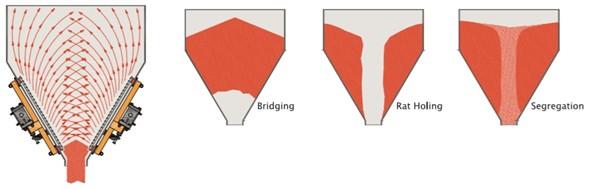
Typical material flow patterns and blockage causes in feeding systems (Source: Dalmec)
Most feeding deviations stem from subtle changes in material conditions rather than obvious equipment failures. Ultra-fine powder, low-density blends and viscous additives are prone to abnormal flow, which is hard to detect in a timely manner. Common problems are listed as follows:
Bridging: Materials form an arch-shaped accumulation above the discharge outlet.
Ratholing: Materials flow only through a narrow central gap.
Material Segregation: Materials separate automatically according to particle size and density.
When the above situations occur, the feeder seems to operate normally, yet the actual feeding volume and material ratio have already deviated from the set values.
In addition, hopper refilling will change the static pressure, compaction degree and ventilation state of materials. For volumetric feeding systems, this will easily further aggravate feeding deviations.
Improper calibration also leads to increased feeding deviations. Many enterprises only perform calibration once during equipment commissioning and production startup, assuming the parameters remain effective permanently.
In fact, calibration parameters need to be flexibly adjusted according to material types, feeding volume and on-site production environments. Parameters applicable to one batch of masterbatch may not work for another batch of raw materials. Recalibration is mandatory after equipment maintenance, screw replacement, material change and seasonal humidity fluctuations.
Regular recheck and calibration are indispensable for production involving low-proportion addition and high-performance additives. Meanwhile, it is necessary to monitor the trend of operating data. Qualified parameters at startup do not mean no feeding deviation will occur during long-term continuous production. Checking feeding status only at startup tends to ignore gradually formed ratio deviations, which will eventually cause unexplained quality fluctuations.
Feeding deviations first manifest as fluctuating product performance, rather than direct production line shutdown failures. Although average indicators such as tensile strength, impact resistance and color of products seem to meet standards, performance gaps keep widening within and across batches.
Such fluctuations undermine process stability, narrow the acceptable process window, and increase the frequency of equipment commissioning and quality inspection workload. They also trigger appearance and dimensional defects including prominent color difference, unstable gloss and warpage. For modified material production, even slight feeding deviations will alter product hardness, shrinkage rate and dimensional stability.
The losses caused are not limited to material waste. They also lead to longer commissioning time, lower production efficiency and increased on-site rectification work. In severe cases, the stability and reliability of the entire production process will be compromised.
For general plastic products and production scenarios with high formula tolerance, volumetric feeders can meet basic production requirements.
However, when manufacturing products with high-performance additives, materials requiring low addition ratios or materials with poor fluidity, feeder selection becomes the key to process and quality control.
Under such circumstances, loss-in-weight feeders show outstanding advantages. They can accurately measure actual feeding weight, reduce the risk of formula deviation and guarantee precise formula ratios.
As the industry sets increasingly stringent requirements on product tolerances and production consistency, the importance of feeding equipment has become more prominent.
 English
 한국어
한국어 français
 Español
 русский
 português
 العربية
 tiếng việt
 Türkçe
 ไทย
ไทย Polska